
Theft Awareness Class: The Complete Guide to Court-Ordered Online Courses (2026)
- Apr 3
- 11 min read
Updated: Apr 6
We agree that legal mandates are inherently stressful, especially when you're forced to choose between a 4-hour and an 8-hour curriculum without clear guidance from the clerk's office. You shouldn't have to risk your future on a program that might not meet 2026 judicial standards.
Our objective is to simplify this bureaucratic process and move you quickly toward total compliance. This guide promises to provide every detail you need to complete a court-accepted, evidence-based program that fits your specific legal requirements. We'll walk you through the enrollment process for our 100% online courses and show you exactly how to secure an instant certificate of completion. You'll learn how to satisfy your obligations and understand behavioral triggers to avoid recidivism, all without missing a single shift at work or a day of school.
Key Takeaways
Identify the core principles of "Corrective Thinking" and how evidence-based programs work to satisfy judicial requirements.
Navigate the differences between Level 1 and Level 2 programs to ensure you enroll in the correct theft awareness class for your specific case.
Confirm the essential standards necessary to guarantee your online certification is recognized and accepted by your local court system.
Learn how to complete your legal mandate efficiently with a 100% online, self-paced curriculum designed for maximum flexibility.
Gain insight into obtaining an instant certificate of completion to provide immediate proof of compliance and resolve your legal matter without delay.
Table of Contents
Understanding the Theft Awareness Class: Purpose and Requirements
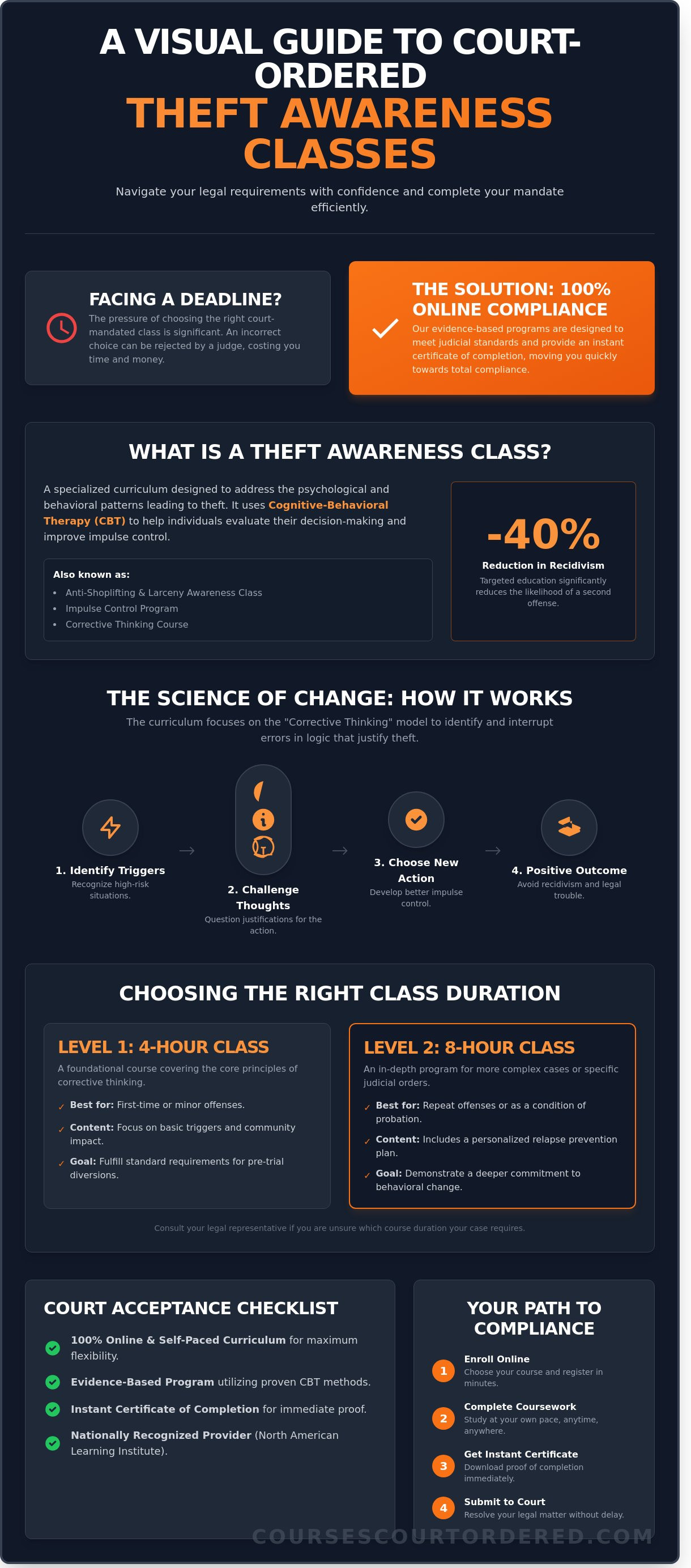
A theft awareness class is a specialized educational curriculum designed to address the psychological and behavioral patterns that lead to shoplifting and larceny. These programs use cognitive-behavioral techniques to help participants evaluate their decision-making processes and develop better impulse control. Courts across the United States frequently use these courses as a standard condition for resolving legal matters. You might see these classes listed under several different names depending on your specific jurisdiction, including:
Anti-Shoplifting Class
Larceny Awareness
Impulse Control Program
Corrective Thinking Course
The legal system mandates these classes because they focus on reducing recidivism. While traditional penalties like fines or community service address the offense, education addresses the root cause. Data from the National Association for Shoplifting Prevention indicates that targeted education can reduce the likelihood of a second offense by approximately 40%. These courses are integrated into various legal paths; this includes pre-trial diversion programs where successful completion may lead to a dismissal of charges, or as a mandatory requirement of a probation sentence.
Who is Required to Take a Theft Awareness Course?
Most participants are directed to a theft awareness class by a legal professional. This group includes judges, prosecutors, probation officers, and defense attorneys who recognize the value of rehabilitation. If you've been instructed to enroll, your legal representative might use the Student Referral form to streamline your enrollment into a 100% Online program. Some individuals also choose to enroll voluntarily before their scheduled court date. This proactive step can demonstrate a high level of responsibility to the court, which often results in more favorable outcomes during sentencing or plea negotiations.
The Goals of Shoplifting Education
The primary objective of shoplifting education is a shift in perspective. Instead of focusing only on the risk of being caught, the curriculum forces an examination of the impact theft has on the local community, small business owners, and the individual's own future. Participants learn to identify specific triggers, such as financial stress or emotional impulses, that lead to the act of theft.
Completing the course provides the court with tangible proof of a commitment to behavioral change. It moves the individual from a state of legal obligation to a state of compliance. When you finish the requirements, you receive an Instant Certificate that serves as official documentation for the court. This document is the final step in proving you've met the state or county requirements for your case.
The Science of Behavioral Change: How Anti-Theft Classes Work
Most court-ordered programs focus on why a person committed a crime, but a high-quality theft awareness class focuses on how to stop it from happening again. Modern curriculum relies heavily on Cognitive Behavioral Therapy (CBT). This method targets the "Corrective Thinking" model, which identifies specific errors in logic that individuals use to justify theft. By examining these thought patterns, students learn to recognize the moment a decision turns toward a legal risk. The North American Learning Institute provides this evidence-based education in a non-judgmental environment. It focuses on impulse control and emotional regulation rather than shame. The curriculum is 100% online, allowing students to focus on these complex behavioral changes at their own pace while meeting judicial requirements.
Identifying the Triggers of Shoplifting
Psychology plays a major role in retail crimes. Triggers often fall into four distinct categories: acute stress, peer pressure, financial anxiety, and thrill-seeking. While some theft is "need-based," occurring due to immediate financial hardship, data from 2023 indicates that a significant portion of shoplifting is "impulse-based." These individuals may use the act to cope with unrelated emotional pain or a perceived lack of control in their lives. Students in our court accepted courses develop a personalized relapse prevention plan. This document identifies their specific high-risk situations and provides a step-by-step guide to making better choices when they feel overwhelmed or pressured.
The Impact of Retail Theft on Society
Retail theft isn't a victimless crime. According to the National Retail Federation’s 2023 National Retail Security Survey, retail shrink accounted for $112.1 billion in losses. This massive economic drain impacts every consumer. Retailers often raise prices by 2% to 5% to cover these losses, which effectively taxes every law-abiding shopper. Beyond the numbers, theft leads to "hidden costs" like reduced store hours, increased security presence that creates a hostile shopping environment, and permanent store closures in high-risk areas. Understanding these consequences helps students see how a single action affects the stability of their local community and the jobs of people working within it. This perspective shift is a vital step toward long-term compliance and personal accountability.
4-Hour vs. 8-Hour Courses: Choosing the Right Duration
Selecting the correct theft awareness class depends entirely on the specific mandate provided by your judge or probation officer. Courts categorize these programs by "Levels" based on the severity of the offense. A Level 1 course typically lasts 4 hours, while a Level 2 course extends to 8 hours. If you complete a 4-hour course when the court required 8, your certificate will likely be rejected; this creates unnecessary delays in your legal proceedings and may lead to non-compliance penalties.
The 4-hour theft awareness class is the standard requirement for first-time offenders or individuals involved in minor infractions, such as low-value shoplifting. It's designed to meet basic diversion program requirements. The 8-hour version provides a more intensive intervention for repeat offenses or as a condition of intensive probation. In approximately 15% of jurisdictions, including specific counties in California and Texas, state laws may even mandate 12-hour or 16-hour programs for felony-level charges or high-value restitution cases.
Curriculum Breakdown: What Is Covered?
The 4-hour curriculum focuses on immediate legal education and personal reflection. Students engage with basic legal definitions, the direct consequences of a conviction, and a self-assessment to identify personal triggers. It's a focused, 100% Online experience that prioritizes rapid compliance and immediate understanding of the law.
The 8-hour curriculum builds upon those foundations with advanced cognitive restructuring techniques. It requires students to analyze the long-term financial impact of their actions on the community and set measurable goals for future behavior. Both formats utilize a strategic mix of video and text content to accommodate different learning styles, ensuring every student can successfully pass the final exam and receive an Instant Certificate. This multi-modal approach is a key reason why our courses remain Court Accepted across various jurisdictions.
How to Verify Your Required Hours
You shouldn't guess which duration you need. Always refer to your official court paperwork, "Order of Probation," or "Judgment of Conviction." These documents explicitly state the required hours. If the paperwork is unclear, call your probation officer or the clerk of court immediately. Taking a shorter theft awareness class than mandated results in a 100% rejection rate by the judicial system, which forces you to pay for and complete a new course from the beginning.
Legal professionals who want to ensure their clients enroll in the correct program should use our referral system to specify the exact course duration needed. This professional process eliminates confusion and ensures the student meets all judicial standards on their first attempt, moving them quickly toward a state of legal relief.
Ensuring Your Certificate is Court Accepted
The most pressing concern for any student is whether their theft awareness class will satisfy the judge. It's a valid worry because legal compliance isn't optional. Courses Court Ordered provides "Court Accepted" programs that are utilized by judicial districts across all 50 U.S. states. Our curriculum isn't just a collection of slides; it's an evidence-based program designed to meet rigorous judicial standards. We partner with the North American Learning Institute (NALI) to ensure every lesson aligns with recognized educational benchmarks. This institutional backing gives judges the confidence that you've completed a high-quality program that addresses the root causes of the offense. Since our courses are 100% Online, you get the benefit of professional-grade education without the logistical headache of in-person seminars.
Verification Checklist for Students
Before you begin your theft awareness class, follow these three steps to ensure total compliance with your legal mandates:
Step 1: Confirm with your attorney or probation officer that an online format is permissible for your specific case. While most jurisdictions accept digital certificates, a quick check prevents future delays.
Step 2: Ensure the course provider is nationally recognized and offers a formal, verifiable certificate. Avoid providers that only offer a basic receipt of payment.
Step 3: Check that the course duration matches your court order exactly. If the judge ordered an 8-hour class, completing a 4-hour version won't satisfy the requirement.
What Information is on the Certificate of Completion?
The final document is your proof of compliance and must contain specific data points to be valid. Every certificate we issue includes the student's legal name, the specific course title, the total hours completed, and the completion date. It's a transparent system that eliminates the risk of fraud and speeds up your legal processing.
We've designed an "Instant Certificate" process to help you meet tight deadlines. Once you pass the final assessment with a score of 60% or higher, the PDF is available for immediate download. You don't have to wait for the mail to prove you've finished.
The Benefits of Fulfilling Your Mandate Online
Choosing an online theft awareness class provides a streamlined path to legal compliance without the logistical hurdles of traditional classrooms. In 2026, approximately 88% of jurisdictions recognize digital certifications as long as the provider meets specific state standards. This shift toward digital learning focuses on removing the barriers that often lead to non-compliance, such as transportation issues or rigid work schedules.
The primary advantage is the 100% Online nature of the program. You don't have to worry about commuting to a physical location or finding parking. You can access the curriculum from any device, whether it's a desktop at home or a smartphone during a break. This convenience ensures that you can prioritize your legal obligations without sacrificing your professional responsibilities.
Flexibility is equally vital for success. Most court-ordered mandates require between 4 and 24 hours of instruction. A self-paced format allows you to break this time into manageable segments. If you have a high-pressure job or family commitments, you can log in for 20 minutes at a time. The system saves your progress automatically, so you never lose your place.
Privacy remains a significant concern for many individuals. Attending an in-person seminar in your local community carries the risk of encountering neighbors or colleagues, which can lead to unnecessary embarrassment. Online courses offer a discreet alternative. You complete your requirements in a private environment, maintaining your confidentiality throughout the process.
Affordability is the final major benefit. In-person counseling or private seminars often cost upwards of $200 when you factor in registration fees and travel expenses. Online options are typically 40% more cost-effective. These courses provide a high-quality, Court Accepted curriculum at a price point that fits most budgets, ensuring that financial constraints don't stand in the way of your certification.
How to Get Started Today
Starting the process is straightforward and takes less than five minutes. First, visit the comprehensive course list to select the theft awareness level specified by your court order. The enrollment process is transparent; there are no hidden fees or surprise charges at the end. Once you register, you gain instant access to the materials. Because the platform is available 24/7, you can begin immediately, which is crucial if you're facing a tight legal deadline. This rapid entry ensures you stay on track for your scheduled court date.
Moving Forward After Completion
The skills you gain during the course go beyond simple legal compliance. You'll explore concepts like corrective thinking and impulse control, which are valuable tools for managing stress in all areas of life. Successfully finishing the program marks a turning point in your legal journey. Once you complete the final module, your Instant Certificate is issued, providing the documentation you need to satisfy the court. You can submit this proof with confidence, knowing you've met every requirement. This is a significant step toward resolving your legal matter and moving forward with a clear focus on your future goals.
Secure Your Compliance and Move Forward Today
Completing a court-mandated requirement doesn't have to be a source of ongoing stress. Whether your specific jurisdiction requires a 4-hour or 8-hour session, selecting a theft awareness class built on a nationally recognized evidence-based curriculum ensures you meet judicial standards the first time. We've updated our 2026 course materials to align with Cognitive Behavioral Therapy (CBT) principles, providing you with the necessary tools for positive behavioral change while fulfilling your legal obligations. Our platform is 100% online and self-paced. This allows you to finish your mandate on your own schedule without the need for inconvenient in-person attendance. Once you pass the final assessment, you'll receive an instant certificate of completion to provide to your probation officer or the court clerk immediately. It's that simple. This streamlined process removes the guesswork from legal compliance, letting you resolve your case with absolute confidence. You have the power to put this requirement behind you today and move forward with your life.
Enroll in a Court-Accepted Theft Awareness Class Today
Frequently Asked Questions
Is an online theft awareness class accepted by all courts?
Most jurisdictions accept online certifications for misdemeanor offenses, provided the provider is accredited. Approximately 95% of courts in the US and Canada recognize our 100% Online format for first-time offenders. You should verify your specific court order requirements before enrolling to ensure compliance. If a judge specifically mandates an in-person session, you must follow that directive to avoid non-compliance issues.
How long does it take to get my certificate of completion?
You'll receive your certificate of completion the moment you finish the final module. There's no waiting for mail or manual processing because this Instant Certificate is available for download in PDF format immediately. This ensures you can meet 24-hour legal deadlines without stress.
What happens if I fail the final test for the shoplifting course?
You can retake the final exam as many times as needed at no additional cost. We provide unlimited attempts to ensure you achieve the required 80% passing score mandated for certification. The material is designed for a 99% first-time pass rate. If you don't pass on your first try, you'll see which sections you missed so you can review the specific modules quickly.
Can I take the theft awareness class on my phone?
Yes, our theft awareness class is fully optimized for smartphones, tablets, and desktop computers. You don't need to download a specialized app or software to access the curriculum. The platform works on all modern browsers including Chrome and Safari. This 100% Online accessibility allows you to complete your court requirements during a lunch break or while commuting, providing a hassle-free experience.
What is the difference between a 4-hour and an 8-hour theft class?
The primary difference is the depth of the curriculum and the specific hours mandated by your court order. A 4-hour Level 1 course typically covers basic impulse control and legal consequences. An 8-hour Level 2 course provides more intensive cognitive behavioral exercises. About 70% of first-time shoplifting cases require the 4-hour version, while repeat offenses or felony reductions often necessitate the 8-hour duration.
Do I have to complete the entire course in one sitting?
You don't have to finish the course all at once because our system automatically saves your progress. You can log in and out as your schedule allows, 24 hours a day. This flexibility is ideal for users balancing work and family commitments. Each time you return, you'll start exactly where you left off. This makes it easy to manage a Court Accepted program on your own terms.
How much does a court-ordered theft awareness class cost?
Enrollment fees for a court-ordered theft awareness class from CoursesCourtOrdered.com typically range from $25 for basic levels to $50 for advanced programs. These prices include the full curriculum and your Instant Certificate. There are no hidden fees for testing or registration. This transparent pricing structure helps you fulfill your legal obligations without unexpected financial strain. You'll know the exact cost before you enter any payment information.


Comments